
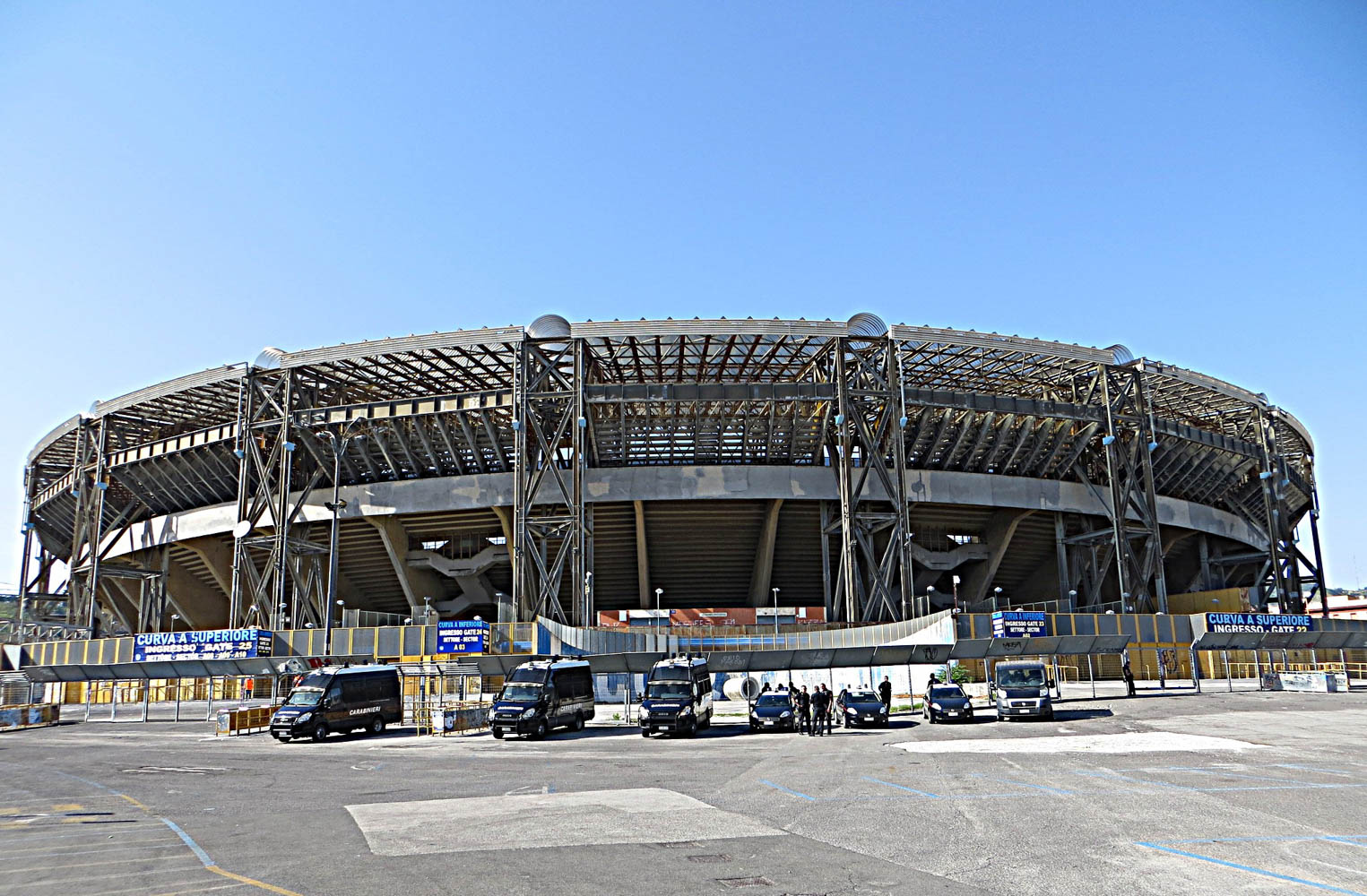

Naples’ football heartbeat, the Stadio Diego Armando Maradona, is a stadium that reflects its city – passionate, proud, and perpetually alive.
Built in the 1950s and opened in 1959, the stadium has been home to SSC Napoli ever since. Formerly known as the Stadio San Paolo, it was renamed in 2020 to honour Diego Maradona, the man who led Napoli to glory and remains an icon of Neapolitan identity.
Stadium Overview
Located in the Fuorigrotta district, around six kilometres west of central Naples, the Maradona is one of Italy’s great sporting arenas. It holds 54,726 spectators in an all-seater layout and is the fourth-largest football stadium in the country, behind San Siro, the Stadio Olimpico, and Bari’s Stadio San Nicola.
Originally called the Stadio del Sole (“Stadium of the Sun”), it opened on 6 December 1959 with Napoli defeating Juventus 2-1. Four years later, it was renamed Stadio San Paolo after Saint Paul, who according to tradition landed nearby on his journey to Rome. In December 2020, following Maradona’s death, the City of Naples unanimously approved the renaming of the ground in his honour – a fitting tribute to the player who delivered two Serie A titles, a Coppa Italia, and the 1989 UEFA Cup to the club.
Architecture and Layout
Constructed mainly from reinforced concrete, the stadium has a distinctive bowl design that captures and amplifies noise. Its initial capacity of over 90,000 was mostly standing room, but successive safety regulations have steadily reduced that figure. Major work for the 1980 European Championship added floodlights and electronic scoreboards, while conversion for the 1990 FIFA World Cup brought an all-seater configuration and partial roof cover.
Further upgrades arrived between 2018 and 2019 ahead of the Summer Universiade. These works – funded by €20 million of investment – modernised the changing rooms, media facilities, and lighting system. Every seat was replaced with wider, more comfortable versions, and glass panels took the place of old metal barriers. The improvements reduced overall capacity but restored a degree of comfort and compliance with UEFA standards.
Matchday Atmosphere
Few stadiums in Europe can match the electricity of the Maradona on a matchday. The roar from the Curva B and Curva A reverberates around the stands, a wall of sound built from drums, chants, and firecrackers. The supporters’ anthem, “O surdato ’nnammurato,” echoes through the air long before kick-off. For many visiting teams, it is an unforgettable and intimidating experience.
Derby fixtures and high-profile clashes, particularly against Juventus or Roma, see the atmosphere reach fever pitch, but even on quieter weekends the passion of Neapolitan fans is constant. Despite the fervour, the environment inside the ground is usually good-natured, with a strong sense of pride and local identity driving the energy rather than hostility.
Tickets and Access
Tickets for Napoli matches can be purchased through official club outlets, the online store, or authorised vendors. Supporters must provide valid photo identification when buying and entering the stadium, as names on tickets are checked at the turnstiles. Prices vary depending on opposition and competition, generally starting around €25 for league fixtures.
Gates open approximately two hours before kick-off. For bigger Serie A or European matches, early arrival is advisable as queues build quickly at both Piazzale Tecchio and Viale Augusto, the main entrances. Away supporters are usually accommodated in the south-eastern sector, securely segregated from home fans.
Getting to the Stadium
The Stadio Diego Armando Maradona is well connected to the rest of the city by public transport, and driving is only recommended for those using dedicated parking.
By Train
- Napoli Campi Flegrei Station: Served by Metropolitan Line 2, it is roughly a ten-minute walk to the stadium.
- Cumana Railway: Stop at Mostra Station for easy access to Piazzale Tecchio.
- Metro Line 6: Also stops at Mostra, a short walk from the main stand.
By Bus
- From Piazza Garibaldi (Central Station), take the ANM 152 to Piazzale Tecchio.
- From Capodichino Airport, take the Alibus to Piazza Garibaldi, then transfer to Metro Line 2 for Campi Flegrei.
- From Piazza Vittoria or the seafront, use routes C18, C19, or 129 heading towards Fuorigrotta.
By Car
Drivers can reach the stadium via the Tangenziale ring road, exiting at Fuorigrotta. On matchdays, surrounding streets are closed or heavily congested, so the recommended option is the Park & Gol service. This park-and-ride system operates from Bagnoli/Viale della Liberazione (Agnano exit), providing secure parking and a dedicated shuttle to the ground. The service, costing €3, covers parking plus return transport for up to five passengers in around ten minutes.
Facilities and Experience
Inside, facilities are practical rather than luxurious. Concession stands offer pizza, panini, and espresso rather than international fast food, maintaining a distinctly Neapolitan flavour. Alcohol is not sold within the ground, but local cafés and bars on Via Galeota and Viale Augusto are lively meeting points before and after matches.
Views from the stands are good throughout, though the running track slightly distances spectators from the pitch. The covered areas of the Tribuna Nisida and Tribuna Posillipo provide the most comfort and best perspective for those seeking a calmer experience.
Hotels Near the Stadium
For supporters travelling to Naples, Fuorigrotta offers several convenient hotels within walking distance. The Hotel Serius on Viale di Augusto is a popular mid-range option with modern rooms and easy metro access. The Hotel Leopardi provides a quieter stay a short distance from Campi Flegrei Station, while the Montespina Park Hotel near Agnano offers a resort-style setting surrounded by greenery.
Pubs and Local Food
Naples is world-famous for its cuisine, and matchday food around the Maradona is an experience of its own. The streets near Piazzale Tecchio fill with stalls selling pizza margherita, cuoppo (fried seafood cones), and sfogliatella pastries. For sit-down options, Pizzeria Fratelli Cafasso and 50 Kalò in nearby Mergellina are highly rated and a short taxi ride away.
Recent Developments
In July 2025, SSC Napoli confirmed plans to construct a new stadium after the Maradona was excluded from Italy’s bid for UEFA Euro 2032. The proposed move marks the end of an era, but for now, the old ground remains alive with energy and devotion. For many fans, no new arena could ever replace the emotion carried within these stands.
Summary
The Stadio Diego Armando Maradona is more than a football ground; it is a monument to Neapolitan culture. From its chaotic charm to its fierce loyalty, every match here captures what football means to Naples – unity, pride, and unrelenting passion. Whether watching under the floodlights or listening to chants spill into the streets, a visit to this stadium is an essential Italian football pilgrimage.
Discover more from Euro Football
Subscribe to get the latest posts sent to your email.



Be the first to comment